
Modern Small Satellites: Changing the Economics of Space
The New Space economy is defined by a shift from bespoke craftsmanship to mass production. Launch cost reductions are only part of the story. The real disruptions are lower CAPEX hurdles, COTS hardware cycles, Ground-Station-as-a-Service, and the regulatory gates that govern low Earth orbit.
- Published
- Jun 9, 2026
- Reading
- 15 min
- Author
- Christopher Lyon
- Filed
- Research
Abstract
For half a century, the space sector was governed by a simple, brutal economic logic: launch was rare, expensive, and risky, meaning payloads had to be built to be near-immortal. This dynamic produced the traditional Geostationary Earth Orbit (GEO) paradigm: multi-tonne, billion-dollar platforms designed to operate for 15 to 20 years without intervention.
The rise of modern small satellites (SmallSats and CubeSats) in Low Earth Orbit (LEO) has broken this cycle. While the public discussion focus is almost exclusively on falling launch costs, the true disruption is a fundamental restructuring of space project finance. By shifting from bespoke engineering to commercial-off-the-shelf (COTS) mass production, utilizing Ground-Station-as-a-Service (GSaaS), and absorbing shorter spacecraft lifespans as a technology upgrade cycle, modern operators have drastically reduced initial capital barriers.
This research note models the life-cycle economics of traditional GEO platforms against LEO small satellite constellations. We analyze the CAPEX-to-OPEX transition, the mechanics of last-mile orbital logistics, and the regulatory gates that have replaced hardware engineering as the primary barrier to entry in the modern space domain.
1. The CAPEX Shift: Lowering the Hurdle Rate
The initial capital hurdle, rather than the 15-year lifecycle cost, is the primary barrier to traditional space operations.
A traditional GEO mission requires assembling the entire capital stack before the first byte of data can be downlinked. To design, build, launch, and insure a bespoke 3,000 kg GEO satellite requires an upfront cash commitment of approximately $480 million. For a startup or commercial operator, this represents a massive financing challenge. The internal rate of return (IRR) required by lenders to absorb this risk is high, and the time-to-first-revenue is typically 36 to 48 months.
In contrast, a LEO constellation can be deployed incrementally. To build and launch the first generation (Gen 1) of a 100-satellite constellation to provide global coverage requires roughly $270 million. More importantly, this constellation can begin delivering partial services and generating revenue as soon as the first orbital plane of 10 to 12 satellites is active.
By lowering the initial CAPEX hurdle, SmallSats transform space systems from a market reserved for nation-states and legacy defense primes into one addressable by venture capital and mid-market commercial balance sheets. The investment risk is no longer concentrated in a single, binary launch event; it is distributed across multiple flights and multiple spacecraft.
2. Standardization and the COTS Revolution
The physical driver of LEO economics is the standardization of the spacecraft bus.
Historically, every satellite was an original work of engineering craftsmanship. The structural frame, electrical power system (EPS), attitude determination and control system (ADCS), and communications payloads were designed from scratch to optimize mass for a specific launch vehicle and mission profile.
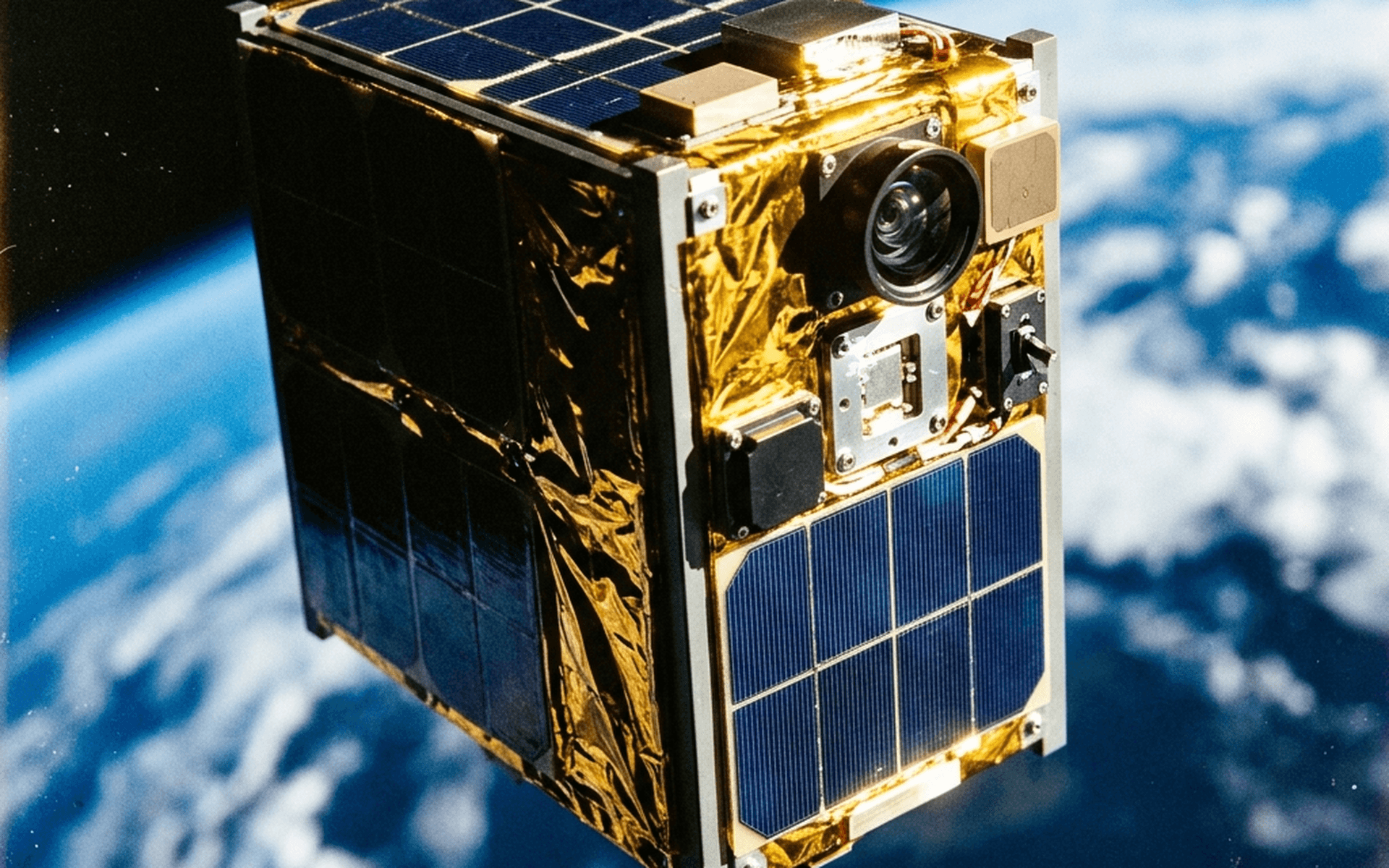
The introduction of the CubeSat standard, defined by Stanford professor Robert Twiggs and CalPoly professor Jordi Puig-Suari in 1999, changed this by establishing a fixed structural unit: 1U (10 × 10 × 10 cm, weighing roughly 1.33 kg). Standardizing the interface allowed third-party vendors to manufacture Commercial-Off-The-Shelf (COTS) components that are guaranteed to fit and function together. This standardization scales from basic 1U educational payloads to complex science platforms like Arizona State University's LunaH-Map, a 6U CubeSat built to map hydrogen at the lunar south pole.1NASA. LunaH-Map: Mapping Hydrogen at the Lunar South Pole. NASA Ames Research Center. Accessed June 2026. https://www.nasa.gov/lunah-map
Today, an operator building a 12U CubeSat does not design reaction wheels, magnetorquers, or solar arrays. They purchase them from catalogs provided by suppliers like NanoAvionics, ISISPACE, or Pumpkin Space Systems. The cost implications of this shift are clear:
- Non-Recurring Engineering (NRE) reduction: amotizing design costs across thousands of standardized units reduces NRE from tens of millions to negligible levels.
- Supply chain speed: lead times for a custom GEO bus are 18 to 24 months; a COTS CubeSat bus can be delivered in under 8 weeks.
- Hardware cost compression: utilizing industrial-grade electronics (microprocessors, flash memory, and transceiver chips developed for the automotive and smartphone industries) instead of custom, radiation-hardened space-grade equivalents reduces component costs by up to two orders of magnitude.2Sinclair, D. & Dyer, J. Radiation Mitigation in COTS-based CubeSats. 27th Annual AIAA/USU Conference on Small Satellites, SSC13-IV-1, 2013. https://digitalcommons.usu.edu/smallsat/2013/all2013/32/
While COTS components have a higher susceptibility to radiation-induced Single Event Effects (SEEs) in orbit, LEO orbits (300 km to 600 km) sit within the protective envelope of Earth’s magnetosphere. The lower radiation environment, combined with system-level software redundancy (e.g., watchdog timers, triple-modular redundancy in microcontrollers), makes the risk of COTS components highly manageable over 3-to-7-year mission profiles.
3. Launch Costs: The Rideshare and Space Tug Stack
While falling launch costs are highly visible, the key economic driver is the shift from custom, dedicated vehicles to standardized rideshare logistics.
As of 2026, SpaceX's SmallSat Rideshare Program (which includes the Transporter and Bandwagon missions) has set the baseline pricing at $350,000 for up to 50 kg, with a marginal rate of $7,000 per additional kilogram.3SpaceX. SmallSat Rideshare Program: Pricing and Booking. Accessed June 2026. https://www.spacex.com/rideshare/ - baseline price adjusted to \$350,000 for up to 50 kg, with incremental mass at \$7,000/kg. This represents a dramatic drop compared to the $15,000 to $20,000/kg rates common during the shuttle and early Delta/Atlas eras.
However, rideshare launches deposit all payloads into a single, generic "parking orbit" (typically a sun-synchronous orbit at 500–550 km). For a constellation operator, this creates a logistics bottleneck: satellites must be distributed across multiple orbital planes and local times of ascending node (LTAN) to achieve global coverage.
To bridge this "last mile," the modern launch stack incorporates Orbital Transfer Vehicles (OTVs) or "space tugs," such as:
- D-Orbit's ION Satellite Carrier: designed for precision deployment and hosting of small payloads.
- Impulse Space's Mira and Helios: high-performance, chemical-propulsion transfer stages designed to move payloads from rideshare drop points to operational orbits.
Traditional Dedicated Launch:
[Launcher] =======================================> [Target Orbit] (Expensive, Custom)

LEO Rideshare + Space Tug:
[SpaceX Rideshare] ===> [Parking Orbit]
                           \==> [OTV / Space Tug] ===> [Target Orbit A] (Cheap, Standardized)
                           \==> [OTV / Space Tug] ===> [Target Orbit B]
Using an OTV adds approximately $150,000 per satellite in integration and dispersion fees.4European Spaceflight. Orbital Transfer Vehicles: The Last Mile of Space Logistics. January 2026. https://europeanspaceflight.com/orbital-transfer-vehicles-the-last-mile-of-space-logistics/ The trade-off is highly favorable: rather than paying $5 million for a dedicated light launcher (such as a Rocket Lab Electron or Firefly Alpha) to reach a specific custom orbit, an operator can pay $1.2 million for a rideshare slot plus space tug dispersion, capturing the economies of scale of large launch vehicles while retaining orbital precision.
4. Ground Segment: Turning CAPEX into OPEX
Historically, building a space constellation required building a corresponding ground constellation. Operators had to construct, license, and maintain proprietary ground stations, which cost millions of dollars per site, to command satellites and download payload data. This created high fixed operating costs and limited data download frequency to times when satellites passed directly over proprietary dishes.
The modern landscape uses Ground Station as a Service (GSaaS), led by networks like Kongsberg Satellite Services (KSATlite) and AWS Ground Station.
GSaaS providers build global networks of tracking antennas and rent them to satellite operators on a pay-per-use basis. The economic shifts are structural:
- CAPEX to OPEX: ground segment costs are converted from upfront capital investments into a variable operating expense.
- Utilization optimization: AWS Ground Station offers antenna time starting at approximately $3.00 per minute for narrowband contact and $10.00 to $22.00 per minute for wideband contacts under reserved contracts.5AWS. AWS Ground Station Pricing. Amazon Web Services. Accessed June 2026. https://aws.amazon.com/ground-station/pricing/ Operators pay only when their satellites are in active contact.
- Latency reduction: utilizing a shared global network of 20+ ground stations ensures that a satellite is rarely more than a few minutes away from a downlink point, drastically reducing the data latency that degrades the value of Earth observation and weather payloads.
This cloud-native integration extends to flight operations. Modern constellations use automated, API-driven mission control software (e.g., Kubos, Bright Ascension) hosted in standard cloud environments, allowing a fleet of 100 satellites to be managed by a flight dynamics team of just two or three operators.
5. The Orbital Lifecycle and Tech Obsolescence
One of the most persistent criticisms of small satellites is their short operational lifespan, which is typically 3 to 7 years in LEO, compared to 15+ years for a GEO satellite. In classical accounting, a shorter asset life is a disadvantage because it increases the annual depreciation expense and requires continuous capital expenditure for replacement.
In frontier technology sectors, however, a long asset life is a trap.
A GEO satellite launched in 2026 is equipped with processing units, transponders, and sensors designed in 2022. By 2041, that satellite will still be operating, but it will be competing against terrestrial systems and newer space platforms that are four generations ahead in computing power, spectral efficiency, and sensor resolution. The operator is locked into obsolete hardware that cannot be upgraded.
LEO SmallSat constellations turn this limitation into a strategic advantage. Because LEO satellites are designed for a 5-year lifespan and naturally de-orbit due to atmospheric drag, the operator is forced to launch replacement satellites continuously. This replacement schedule aligns the space segment with Moore's Law.
Technology Performance over 15 Years:

GEO (Launched Year 0, Fixed Tech):
Year 0:  [========================= 100% capacity =========================] (Year 15: Obsolete)

LEO Constellation (Upgraded Every 5 Years):
Gen 1 (Yr 0-5):   [=== 100% capacity ===]
Gen 2 (Yr 5-10):  [========= 250% capacity (Updated silicon, new SDRs) =========]
Gen 3 (Yr 10-15): [===================== 600% capacity (Advanced payloads) =====================]
Every new launch batch (typically deployed every 12 to 18 months to replenish the constellation) carries the latest processors, software-defined radios (SDRs), and sensor payloads. The constellation's capabilities evolve dynamically, allowing the operator to adapt to changing market demands, patch software vulnerabilities, and deploy hardware accelerators that did not exist when the program was conceived.
6. Life-Cycle Economics Model: GEO vs. LEO
To quantify these dynamics, we compiled a life-cycle economics model comparing a traditional high-throughput GEO satellite (1 Tbps capacity, 15-year design life) against a LEO constellation (100 satellites, 1.5 Tbps total capacity, 5-year satellite design life requiring three generational cycles to match the 15-year comparison period).
The model incorporates SpaceX's 2026 rideshare rates ($7,000/kg incremental over 50 kg), $150k per satellite OTV integration, standardized commercial FCC licensing, and GSaaS operating expenses. It assumes a 10% cost reduction per generation for the LEO constellation manufacturing and launch due to learning curves and production volume optimization.6Lyon, C. GEO vs. LEO Constellation Life-Cycle Cost Model. Lyon Industries Space Systems Research Note, Workspace Code: economicsmodel.py, June 2026.
The output of the lifecycle comparison:
| Metric | GEO Satellite | LEO Constellation |
|---|---|---|
| System Concept | Traditional GEO (1 Tbps) | LEO Constellation (100 Sats, 1.5 Tbps) |
| Design Lifespan (Satellite) | 15 Years | 5 Years |
| Total Capacity | 1,000 Gbps | 1,500 Gbps |
| Initial Gen 1 CAPEX | $480,000,000 | $270,000,000 |
| - Satellite Manufacturing | $250,000,000 | $120,000,000 |
| - Launch Services | $90,000,000 | $120,000,000 |
| - Program NRE & R&D | $100,000,000 | $15,000,000 |
| - Insurance, Licensing & Legal | $40,000,000 | $15,000,000 |
| Annual Ground OPEX | $15,000,000 | $5,000,000 |
| 15-Year Lifetime OPEX | $225,000,000 | $75,000,000 |
| 15-Year Total Cost (CAPEX+OPEX) | $705,000,000 | $755,400,000 |
| Cost per Gbps per Year | $47,000.00 | $33,573.33 |
| Resiliency Profile | Binary (100% loss on single failure) | Graceful (5% sat failure = 5% capacity loss) |
| Tech Obsolescence Risk | Locked for 15 years | Upgraded every 5 years |
Analysis of the Financial Output
While the 15-year total lifecycle cost of the LEO constellation is slightly higher ($755.4M vs $705.0M) due to the necessity of launching three generations of hardware, its unit economics are 28% superior ($33,573.33 per Gbps/year vs $47,000.00 for GEO) because of the higher raw capacity and lower ground segment overhead.
More importantly, the LEO constellation delivers these superior unit economics while requiring 43.7% less upfront capital ($270M vs $480M) to deploy the first generation. This significantly reduces the cost of capital and changes the net present value (NPV) dynamics of the business case: early revenues from Gen 1 can fund the manufacturing and launch of Gen 2 and Gen 3, reducing the need for dilutive equity or high-interest debt financing.
7. The Regulatory Bottleneck: Spectrum and Slot Coordination
As hardware costs have fallen and launch availability has increased, the primary barrier to entry in the space sector has shifted from physics to administration.
In modern space operations, spectrum and orbital space have replaced titanium and silicon as the primary scarce resources.
Spectrum Allocation
Every satellite requires radio frequency (RF) spectrum to uplink commands and downlink data. Spectrum is globally coordinated by the International Telecommunication Union (ITU) and licensed nationally by bodies like the Federal Communications Commission (FCC) in the United States.
Because LEO constellations involve hundreds of satellites operating in the same frequency bands, coordinating spectrum to prevent mutual interference is a complex, legally intense process.
The FCC has established a streamlined licensing process for qualifying small satellites (under 10 spacecraft, short life, limited power) with an application fee of approximately $30,000.7Federal Communications Commission. Streamlining Licensing Procedures for Small Satellites. FCC Report and Order, FCC 19-81, IB Docket No. 18-86. https://www.fcc.gov/document/fcc-streamlines-licensing-procedures-small-satellites However, standard commercial constellation filings do not qualify for this stream. They require full filings, international coordination, and detailed RF interference analyses. Operators typically budget $25,000 to $500,000 in professional fees for specialized legal counsel and RF engineering firms to prepare these applications, and the approval timeline can stretch from 6 to 18 months.8Satnews. Navigating the Regulatory Scarcity of Space: Spectrum and Licensing. March 2026. https://news.satnews.com/2026/03/12/navigating-the-regulatory-scarcity-of-space-spectrum-and-licensing/
Orbital Debris Mitigation
Regulators are increasingly concerned with space sustainability. Any commercial operator filing for a license must submit a detailed orbital debris mitigation plan.
In the U.S., the FCC implemented a "5-year rule" requiring satellites operating in LEO to be de-orbiting or actively disposed of within five years of completing their mission.9Federal Communications Commission. FCC Adopts New 5-Year Rule for Deorbiting LEO Satellites to Control Space Debris. September 2022. FCC-22-74, IB Docket No. 22-271. https://www.fcc.gov/document/fcc-adopts-new-5-year-rule-deorbiting-satellites Meeting this requirement requires incorporating passive de-orbit systems (such as drag sails) or active propulsion systems, adding weight and complexity to the satellite and increasing testing and manufacturing costs.
8. Risks and Invalidation Gates
The economics of LEO SmallSats are highly favorable, but they depend on several structural assumptions. If these assumptions are invalidated, the business case degrades rapidly.
A. Launch Congestion and Price Escalation
The entire LEO business model is built on cheap rideshare launch access. SpaceX currently dominates this market. If SpaceX encounters a prolonged grounding of its Falcon 9 fleet (due to a launch anomaly or regulatory investigation), or if it chooses to exercise its market power to increase rideshare pricing (as seen in the rise from historical $5,000/kg rates to the current $7,000/kg baseline), LEO constellation economics will suffer. A 20% increase in launch costs translates to an immediate $24 million capital penalty for each constellation refresh cycle.
B. Atmospheric Drag and Solar Storms
Low Earth Orbit is not a perfect vacuum. Solar activity (specifically solar flares and coronal mass ejections) heats and expands the upper atmosphere, increasing density at LEO altitudes. During the solar maximum, atmospheric drag at 500 km can increase by an order of magnitude. In 2022, SpaceX lost 40 Starlink satellites in a single launch because a geomagnetic storm prevented them from raising their orbits.10SpaceNews. SpaceX loses 40 Starlink satellites to geomagnetic storm. February 2022. https://spacenews.com/spacex-loses-40-starlink-satellites-to-geomagnetic-storm/ Constellation operators must budget for higher propulsion margins (and thus higher satellite mass and cost) to survive unexpected space weather events.
C. The "Kessler Syndrome" and Collision Avoidance OPEX
As the number of active satellites and debris pieces in LEO grows, the probability of collision increases. While active collision is rare, the threat of collision requires continuous operational monitoring. Every conjunction warning (when orbital tracking indicates two objects will pass close to each other) requires satellite operators to evaluate the risk and potentially execute an avoidance maneuver. These maneuvers consume propellant (reducing satellite lifespan) and demand engineering resources, increasing Ground OPEX. If orbital debris density reaches a point where automated collision avoidance is ineffective or requires daily maneuvers, LEO constellations will become operationally unviable.
9. Strategic Playbook for Space Operators
For organizations entering the modern space domain, the economic data points to a clear strategic playbook:
- Avoid Bespoke Architectures: Design payloads to fit standard CubeSat (3U, 6U, 12U) or ESPA-ring class form factors. Never design a custom structural bus unless the payload physics absolutely demands it. Leverage COTS suppliers to minimize NRE and accelerate time-to-market.
- Prioritize the Regulatory Filing: Begin the FCC and ITU licensing process before freezing the hardware design. The legal and regulatory timeline is often longer than the engineering build cycle. A finished satellite sitting in a cleanroom because it lacks a spectrum license is a stranded capital asset.
- Outsource Infrastructure (GSaaS): Do not build proprietary ground stations. Utilize KSATlite, AWS Ground Station, or Infostellar to convert ground segment capital costs into variable operating costs. Focus engineering resources on core payload algorithms and data processing rather than antenna mechanics.
- Design for Obsolescence: Build satellites under the assumption that they will be replaced in 4 to 5 years. Do not waste capital over-engineering components for 15-year lifespans. Invest instead in software-defined payloads (SDRs, FPGAs) that can be reconfigured in orbit, and use the natural orbital decay of LEO to clear space for the next generation of hardware.
- Leverage Dual-Use Co-Products: Capital flows toward space programs that have immediate terrestrial applications. The most successful commercial space plays are those whose core technology (such as advanced silicon or software-defined radios) can be commercialized on Earth to generate cash flow while the space constellation is being deployed.
Conclusion
The transition from traditional GEO satellites to modern LEO SmallSat constellations represents a structural reorganization of space commerce. By reducing the initial CAPEX hurdle by over 40% and compressing unit capacity costs by nearly 30%, modern small satellites have unlocked the commercial viability of Low Earth Orbit.
However, this transition shifts the operational challenges. Success in the modern space sector belongs to operators who can navigate spectrum licensing, optimize orbital logistics stacks, build software-defined payloads, and treat their space assets as rapidly iterating nodes in a global, cloud-native network.
The launch pads are ready. The regulatory filing is the bottleneck. Build accordingly.
Last revised 2026-06-09. Citations below trace load-bearing claims to primary and regulatory sources. Technical models and economic simulation scripts live in the post's working directory and are excluded from the public site.
Footnotes
-
NASA. LunaH-Map: Mapping Hydrogen at the Lunar South Pole. NASA Ames Research Center. Accessed June 2026. https://www.nasa.gov/lunah-map ↩
-
Sinclair, D. & Dyer, J. Radiation Mitigation in COTS-based CubeSats. 27th Annual AIAA/USU Conference on Small Satellites, SSC13-IV-1, 2013. https://digitalcommons.usu.edu/smallsat/2013/all2013/32/ ↩
-
European Spaceflight. Orbital Transfer Vehicles: The Last Mile of Space Logistics. January 2026. https://europeanspaceflight.com/orbital-transfer-vehicles-the-last-mile-of-space-logistics/ ↩
-
AWS. AWS Ground Station Pricing. Amazon Web Services. Accessed June 2026. https://aws.amazon.com/ground-station/pricing/ ↩
-
Lyon, C. GEO vs. LEO Constellation Life-Cycle Cost Model. Lyon Industries Space Systems Research Note, Workspace Code:
economics_model.py, June 2026. ↩ -
Federal Communications Commission. Streamlining Licensing Procedures for Small Satellites. FCC Report and Order, FCC 19-81, IB Docket No. 18-86. https://www.fcc.gov/document/fcc-streamlines-licensing-procedures-small-satellites ↩
-
Satnews. Navigating the Regulatory Scarcity of Space: Spectrum and Licensing. March 2026. https://news.satnews.com/2026/03/12/navigating-the-regulatory-scarcity-of-space-spectrum-and-licensing/ ↩
-
Federal Communications Commission. FCC Adopts New 5-Year Rule for Deorbiting LEO Satellites to Control Space Debris. September 2022. FCC-22-74, IB Docket No. 22-271. https://www.fcc.gov/document/fcc-adopts-new-5-year-rule-deorbiting-satellites ↩
-
SpaceNews. SpaceX loses 40 Starlink satellites to geomagnetic storm. February 2022. https://spacenews.com/spacex-loses-40-starlink-satellites-to-geomagnetic-storm/ ↩